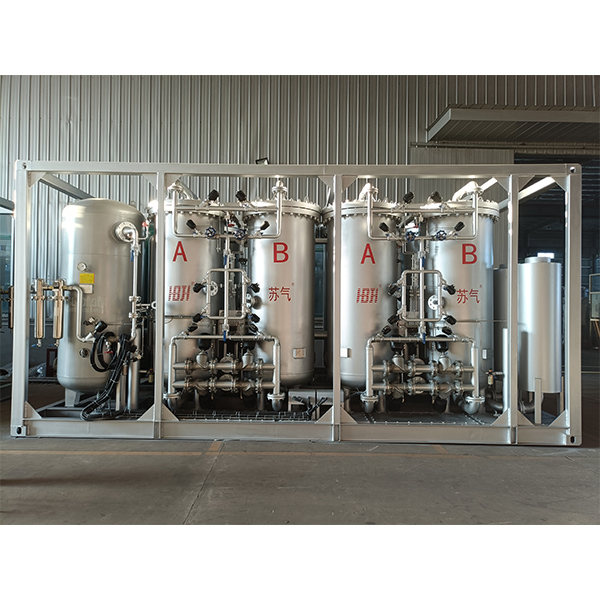
SQFD Series | High-Purity Nitrogen Generation with Optimized Air Consumption
Product Overview
The Ultra-Low Air Consumption PSA Nitrogen Generator is designed for industrial applications where nitrogen purity, continuous gas supply, and compressed-air efficiency are equally important.
Using Pressure Swing Adsorption (PSA) technology and high-performance Carbon Molecular Sieve (CMS), the system separates nitrogen from compressed air at ambient temperature. Its optimized adsorption and regeneration process reduces the amount of compressed air required to produce each unit of nitrogen, helping lower the operating load of the upstream air compressor.
The SQFD series is available in different configurations, including twin-tower, four-tower, six-tower and eight-tower systems, allowing the nitrogen production capacity to be matched to different industrial requirements.
Depending on the selected model and purity level, nitrogen purity can reach 99.9995% with oxygen content as low as 5 ppm.
Why Choose an Ultra-Low Air Consumption Nitrogen Generator?
For a PSA nitrogen plant, nitrogen production capacity alone does not determine operating cost. The amount of compressed air required to produce each unit of nitrogen is also a critical factor.
The air-to-nitrogen ratio describes the approximate amount of compressed air required to produce a given amount of nitrogen. A lower ratio generally means less compressed-air demand and a lower load on the air compressor.
The SQFD series is designed around this principle.
Key benefits
- Ultra-low compressed air consumption
- Air-to-nitrogen ratio from 3.0:1 to 6.0:1, depending on purity and operating conditions
- Nitrogen purity up to 99.9995%
- Oxygen content as low as ≤5 ppm
- Multiple tower configurations for different capacity requirements
- Stable and adjustable nitrogen flow
- Automated PSA operation
- Compact and modular system design
- Reduced compressor load and operating energy demand
- Easy operation and routine maintenance
- Suitable for continuous industrial nitrogen production
The relationship between purity and air consumption is important: higher nitrogen purity generally requires more compressed air because more oxygen must be removed from the feed air. This is why the air-to-nitrogen ratio should be considered together with purity and required flow when sizing a nitrogen system.
Working Principle
The Ultra-Low Air Consumption PSA Nitrogen Generator uses Carbon Molecular Sieve (CMS) to selectively adsorb oxygen from compressed air.
1. Compressed Air Preparation
Ambient air is compressed and treated before entering the nitrogen generator. The feed air should meet the required pressure, cleanliness and dew-point conditions to protect the CMS and pneumatic components.
2. Adsorption
During the adsorption stage, compressed air enters an adsorption tower filled with carbon molecular sieve.
Oxygen molecules are preferentially adsorbed by the CMS, while nitrogen passes through the adsorption bed and is collected as product gas.
3. Nitrogen Production
The nitrogen-rich gas leaves the adsorption tower and enters the product gas system. Depending on the application, the nitrogen can then be stored in a buffer tank or supplied directly to the production process.
4. Regeneration
When the CMS in one tower approaches its adsorption capacity, the system switches towers.
The saturated tower is depressurized, allowing the adsorbed oxygen to be released and the CMS to regenerate.
5. Continuous Operation
The adsorption and regeneration cycles are controlled automatically by the PLC system. Multiple towers can be arranged to optimize gas production, pressure equalization and regeneration.
This cyclic pressure-swing process is the fundamental operating principle of PSA nitrogen generation.
Ultra-Low Air Consumption Design
The main engineering focus of the SQFD series is not simply increasing nitrogen output, but achieving the required nitrogen purity with an optimized compressed-air requirement.
The system uses a standardized design that can be configured with different numbers of adsorption towers according to capacity requirements.
Twin-Tower Configuration
Suitable for smaller and medium-capacity nitrogen requirements.
Four-Tower Configuration
Provides increased production capacity and more flexible PSA cycling.
Six-Tower Configuration
Designed for higher nitrogen production requirements and continuous industrial operation.
Eight-Tower Configuration
Suitable for large nitrogen demand where high production capacity and continuous operation are required.
This modular approach allows the system to be configured according to the customer's required purity, flow rate, operating pressure and production schedule, rather than using one fixed configuration for all applications.
Main Technical Advantages
1. Optimized Air-to-Nitrogen Ratio
The SQFD series is designed to reduce compressed-air consumption for a given nitrogen output.
Depending on nitrogen purity, the specified air-to-nitrogen ratio ranges from 3.0:1 to 6.0:1 in the 2026 product data.
2. High Nitrogen Purity
The system supports multiple purity levels according to application requirements.
Typical purity specifications include:
- ≥99.9%
- ≥99.95%
- ≥99.99%
- ≥99.995%
- ≥99.999%
- ≥99.9995%
At the highest specified purity level, oxygen content can be controlled to ≤5 ppm.
3. Flexible Capacity
The SQFD series covers different production capacities.
The 2026 standard configurations range from approximately:
65 Nm³/h to 999 Nm³/h at 30°C inlet air temperature, depending on model and nitrogen purity.
For example:
| Model | Purity Range | Nitrogen Flow at 30°C |
|---|---|---|
| SQFD-1C-2 | ≥99.9–99.9995% | 65–180 Nm³/h |
| SQFD-1C-4 | ≥99.9–99.9995% | 130–360 Nm³/h |
| SQFD-1C-6 | ≥99.9–99.9995% | 195–540 Nm³/h |
| SQFD-1C-8 | ≥99.9–99.9995% | 260–720 Nm³/h |
| SQFD-2C-2 | ≥99.9–99.9995% | 75–210 Nm³/h |
| SQFD-2C-4 | ≥99.9–99.9995% | 150–420 Nm³/h |
| SQFD-2C-6 | ≥99.9–99.9995% | 225–630 Nm³/h |
| SQFD-2C-8 | ≥99.9–99.9995% | 300–840 Nm³/h |
Note: The actual nitrogen flow depends on nitrogen purity and inlet air temperature. Please use the detailed model table below for project selection.
Technical Specifications
SQFD-1C Series
| Model | Nitrogen Purity | O₂ Content | N₂ Flow @ 30°C | N₂ Flow @ 20°C | N₂ Flow @ 10°C | Air:N₂ Ratio | Recommended Compressor* |
|---|---|---|---|---|---|---|---|
| SQFD-1C-2 | ≥99.9995% | ≤5 ppm | 65 Nm³/h | 71 Nm³/h | 75 Nm³/h | 6.0:1 | 7.5 Nm³/min |
| ≥99.999% | ≤10 ppm | 80 | 88 | 95 | 5.0:1 | 8.0 | |
| ≥99.995% | ≤50 ppm | 115 | 125 | 135 | 4.0:1 | 9.0 | |
| ≥99.99% | ≤100 ppm | 130 | 143 | 150 | 3.7:1 | 9.3 | |
| ≥99.95% | ≤500 ppm | 165 | 180 | 190 | 3.2:1 | 10.2 | |
| ≥99.9% | ≤1000 ppm | 180 | 201 | 210 | 3.0:1 | 10.5 |
*Compressor capacity is based on the 2026 product specification and should be confirmed according to actual site conditions.
SQFD-1C-4
| Purity | O₂ Content | N₂ Flow @ 30°C | N₂ Flow @ 20°C | N₂ Flow @ 10°C | Air:N₂ Ratio | Compressor |
|---|---|---|---|---|---|---|
| ≥99.9995% | ≤5 ppm | 130 | 142 | 150 | 6.0:1 | 15.0 Nm³/min |
| ≥99.999% | ≤10 ppm | 160 | 176 | 190 | 5.0:1 | 16.0 |
| ≥99.995% | ≤50 ppm | 230 | 250 | 270 | 4.0:1 | 18.0 |
| ≥99.99% | ≤100 ppm | 260 | 286 | 300 | 3.7:1 | 18.6 |
| ≥99.95% | ≤500 ppm | 330 | 360 | 380 | 3.2:1 | 20.4 |
| ≥99.9% | ≤1000 ppm | 360 | 402 | 420 | 3.0:1 | 21.0 |
SQFD-1C-6
| Purity | O₂ Content | N₂ Flow @ 30°C | N₂ Flow @ 20°C | N₂ Flow @ 10°C | Air:N₂ Ratio | Compressor |
|---|---|---|---|---|---|---|
| ≥99.9995% | ≤5 ppm | 195 | 213 | 225 | 6.0:1 | 22.5 Nm³/min |
| ≥99.999% | ≤10 ppm | 240 | 264 | 285 | 5.0:1 | 24.0 |
| ≥99.995% | ≤50 ppm | 345 | 375 | 405 | 4.0:1 | 27.0 |
| ≥99.99% | ≤100 ppm | 390 | 429 | 450 | 3.7:1 | 27.9 |
| ≥99.95% | ≤500 ppm | 495 | 540 | 570 | 3.2:1 | 30.6 |
| ≥99.9% | ≤1000 ppm | 540 | 603 | 630 | 3.0:1 | 31.5 |
SQFD-1C-8
| Purity | O₂ Content | N₂ Flow @ 30°C | N₂ Flow @ 20°C | N₂ Flow @ 10°C | Air:N₂ Ratio | Compressor |
|---|---|---|---|---|---|---|
| ≥99.9995% | ≤5 ppm | 260 | 284 | 300 | 6.0:1 | 30.0 Nm³/min |
| ≥99.999% | ≤10 ppm | 320 | 352 | 380 | 5.0:1 | 32.0 |
| ≥99.995% | ≤50 ppm | 460 | 500 | 540 | 4.0:1 | 36.0 |
| ≥99.99% | ≤100 ppm | 520 | 572 | 600 | 3.7:1 | 37.2 |
| ≥99.95% | ≤500 ppm | 660 | 720 | 760 | 3.2:1 | 40.8 |
| ≥99.9% | ≤1000 ppm | 720 | 804 | 840 | 3.0:1 | 42.0 |
SQFD-2C Series
The SQFD-2C series provides another capacity configuration for industrial nitrogen production.
| Model | Purity Range | O₂ Content Range | N₂ Flow @ 30°C | Air:N₂ Ratio |
|---|---|---|---|---|
| SQFD-2C-2 | ≥99.9–99.9995% | ≤1000–5 ppm | 75–210 Nm³/h | 3.0–6.0:1 |
| SQFD-2C-4 | ≥99.9–99.9995% | ≤1000–5 ppm | 150–420 Nm³/h | 3.0–6.0:1 |
| SQFD-2C-6 | ≥99.9–99.9995% | ≤1000–5 ppm | 225–630 Nm³/h | 3.0–6.0:1 |
| SQFD-2C-8 | ≥99.9–99.9995% | ≤1000–5 ppm | 300–840 Nm³/h | 3.0–6.0:1 |
For detailed engineering selection, the complete 2026 performance table should be displayed with the product documentation or provided by Hongbo's engineering team.
Compressed Air Requirements
The quality of compressed air directly affects PSA nitrogen generator performance, CMS service life and overall system stability.
For the SQFD series, the 2026 product specification gives the following feed-air requirements:
| Parameter | Requirement |
|---|---|
| Compressed Air Pressure | >0.7 MPa and ≤0.8 MPa |
| Residual Oil Content | <0.001 ppm |
| Mechanical Impurities | ≤0.1 μm |
| Pressure Dew Point | ≤8°C |
The upstream compressed-air system should therefore normally include suitable air filtration, cooling, drying and oil-removal treatment before the air enters the PSA nitrogen generator.
Main System Components
A complete ultra-low air consumption PSA nitrogen generation system can include:
- Compressed air treatment system
- Air buffer tank
- PSA adsorption towers
- Carbon molecular sieve
- Pneumatic valves
- Solenoid valves
- Check valves
- Pressure regulating components
- Nitrogen buffer tank
- Nitrogen analyzer
- Flow meter
- Pressure gauges
- PLC control system
- HMI / touchscreen
- Silencer
- Connecting pipelines and fittings
The PSA section itself consists primarily of adsorption vessels, CMS, valves, gas distribution components and an automated control system. This general configuration is consistent with common industrial PSA nitrogen-generator architecture.
Automation and Control
The nitrogen generator is designed for automatic cyclic operation.
The PLC control system manages:
- Adsorption and regeneration cycles
- Tower switching
- Pressure control
- Automatic operation sequences
- Nitrogen purity monitoring
- Product gas discharge
- System alarms and protection
An online oxygen analyzer can be integrated to monitor nitrogen purity continuously.
This allows the operator to monitor the nitrogen generation process without manually controlling individual adsorption cycles.
Industrial Applications
The Ultra-Low Air Consumption PSA Nitrogen Generator is suitable for applications where nitrogen is required continuously and where compressed-air efficiency is important.
Metal Heat Treatment
Nitrogen can be used as a protective atmosphere during:
- Annealing
- Sintering
- Heat treatment
- Furnace protection
- Metal processing
Chemical Industry
Typical applications include:
- Tank blanketing
- Pipeline purging
- Chemical process protection
- Inert gas applications
- Oxygen displacement
Food and Beverage
Nitrogen can be used for:
- Modified atmosphere packaging
- Oxygen removal
- Food preservation
- Beverage tank blanketing
Pharmaceutical Industry
Applications include:
- Nitrogen filling
- Oxygen displacement
- Packaging protection
- Inert atmosphere applications
Electronics and Semiconductor Manufacturing
High-purity nitrogen can be used as a protective gas during manufacturing and processing where oxygen and moisture control are important.
Rubber and Plastics
Nitrogen can be used as a protective or inert gas during selected manufacturing processes.
PSA nitrogen generation is commonly used across these industrial sectors because nitrogen can be generated onsite from compressed air rather than delivered as cylinders or bulk liquid gas.
How to Select the Right Model
Selecting an ultra-low air consumption nitrogen generator should not be based on flow rate alone.
Hongbo recommends evaluating the following parameters:
1. Required Nitrogen Purity
For example:
- General inerting → ≥99.9%
- Food / industrial applications → typically 99.9–99.99%
- Higher-purity industrial processes → ≥99.995%
- Sensitive applications → ≥99.999% or higher
2. Required Nitrogen Flow
Determine:
Average nitrogen consumption + peak consumption + required operating margin
rather than selecting a generator based only on the average flow.
3. Required Oxygen Content
Nitrogen purity and oxygen content are directly related.
For example:
99.9995% nitrogen → O₂ ≤5 ppm
4. Available Compressed Air
The compressor must provide sufficient flow at the required pressure.
An undersized compressor can directly affect nitrogen production and purity.
5. Operating Temperature
The 2026 specification provides different nitrogen flow values for 30°C, 20°C and 10°C inlet-air conditions, so local operating temperature should be considered when selecting the model.
6. Operating Hours
For plants operating continuously, compressed-air consumption can have a significant impact on long-term operating cost. Therefore, the air-to-nitrogen ratio should be considered as an important selection parameter.
Ultra-Low Air Consumption vs. Conventional PSA Nitrogen Generation
| Parameter | Conventional PSA Design | Ultra-Low Air Consumption Design |
|---|---|---|
| Nitrogen Source | Compressed air | Compressed air |
| Separation Technology | PSA | Optimized PSA |
| CMS Adsorbent | Carbon molecular sieve | High-performance CMS |
| Air Consumption | Application dependent | Optimized for lower consumption |
| Air:N₂ Ratio | Depends on purity and design | Approx. 3.0:1–6.0:1 in specified models |
| Nitrogen Purity | Application dependent | Up to ≥99.9995% |
| Automation | PLC available | Automated PLC control |
| Configuration | Fixed / modular | Twin, four, six or eight towers |
| Operating Cost | Depends on compressor load | Designed to reduce compressed-air demand |
Important: The actual energy-saving benefit depends on nitrogen purity, production flow, inlet air conditions, compressor efficiency, operating hours and the complete compressed-air system. It should therefore be evaluated on a project-specific basis rather than using a fixed percentage saving.
Frequently Asked Questions
What is an ultra-low air consumption nitrogen generator?
It is a PSA nitrogen generation system optimized to reduce the amount of compressed air required to produce a specified amount of nitrogen. The key performance indicator is the air-to-nitrogen ratio.
What nitrogen purity can the SQFD series produce?
The 2026 specification covers purity levels from ≥99.9% to ≥99.9995%, with oxygen content as low as ≤5 ppm.
What is the air-to-nitrogen ratio?
The air-to-nitrogen ratio indicates how much compressed air is required to produce a unit volume of nitrogen under specified operating conditions. For the SQFD series, the specified ratio ranges from approximately 3.0:1 to 6.0:1, depending on purity.
Does higher nitrogen purity require more compressed air?
Generally, yes. Higher purity requires more effective oxygen removal, so compressed-air consumption normally increases. This relationship is reflected in the SQFD technical tables.
What compressed-air pressure is required?
The 2026 specification requires feed air at more than 0.7 MPa and no more than 0.8 MPa.
Can the nitrogen purity and flow rate be customized?
Yes. The appropriate PSA configuration can be selected according to required purity, nitrogen flow, oxygen content, operating pressure, inlet-air temperature and site conditions.
Can the system operate continuously?
Yes. PSA nitrogen generators use cyclic adsorption and regeneration. With suitable compressed-air preparation and maintenance, the system is designed for continuous industrial operation.
What industries use this type of nitrogen generator?
Typical applications include metal heat treatment, chemical processing, food packaging, pharmaceuticals, electronics, semiconductor manufacturing, rubber and plastics, tank blanketing and pipeline purging.
Why Hongbo
Engineering-Based Nitrogen Solutions
Hongbo designs nitrogen generation systems according to the customer's actual nitrogen demand, purity requirement, compressed-air conditions and operating environment.
Customized System Configuration
Different tower configurations, nitrogen capacities and purity levels can be selected according to project requirements.
Complete Nitrogen Generation System
The solution can be engineered around the PSA generator, compressed-air treatment, buffer storage, nitrogen monitoring and control system.
Designed for Long-Term Operation
The system focuses on stable nitrogen production, automated operation and reduced compressed-air consumption for industrial applications.