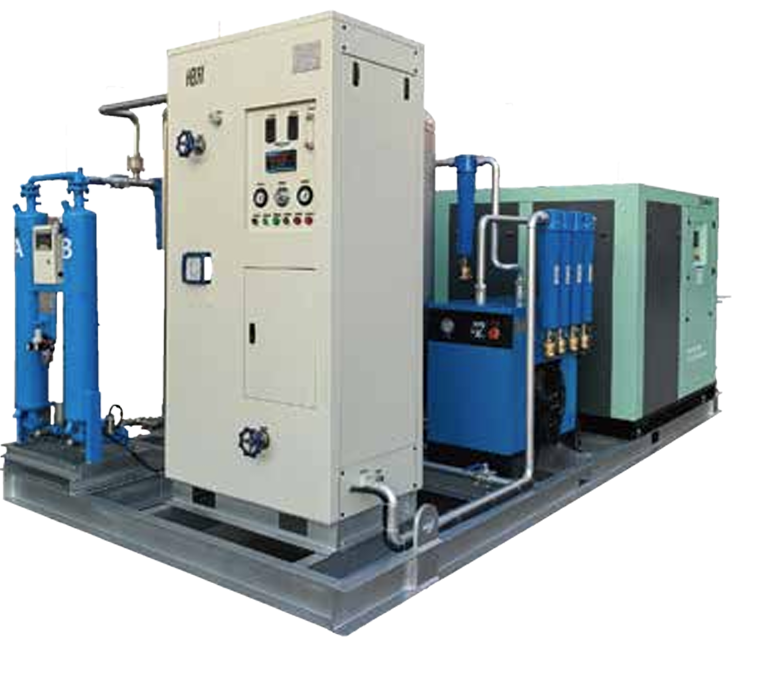
On-Site Nitrogen Generation with Membrane Separation Technology
Hongbo Membrane Separation Nitrogen Generator is an on-site nitrogen generation system that separates nitrogen from compressed air by utilizing the different permeation rates of gas molecules through polymer membranes.
After compressed air is properly purified, it enters the membrane separation unit. Gas components with relatively faster permeation rates pass through the membrane preferentially, while nitrogen, which permeates more slowly, is retained and enriched as the product gas.
The system features a relatively simple separation process, few moving parts, low maintenance requirements and modular capacity expansion, making it suitable for industrial applications requiring a continuous and reliable nitrogen supply.
Hongbo provides two standard series:
- HBFM95 Series: 50–2000 Nm³/h
- HBFM99 Series: 15–2000 Nm³/h
The appropriate system configuration can be selected according to the required nitrogen flow, operating conditions and actual process requirements.
How Does a Membrane Nitrogen Generator Work?
Membrane nitrogen generation is based on selective permeation.
Different components of compressed air have different permeation and diffusion rates through the polymer membrane material. When purified compressed air enters the membrane module, gases with relatively faster permeation characteristics are separated through the membrane, while nitrogen permeates more slowly and becomes concentrated in the product gas stream.
In a typical membrane nitrogen generation process:
Compressed Air → Air Purification → Membrane Separation → Nitrogen Outlet
The air purification stage is important because the compressed air must be properly treated before entering the membrane modules. The membrane separation stage then performs the actual gas separation.
This is a physical separation process. Industrial membrane nitrogen generators commonly use hollow-fiber membrane modules to provide a large effective membrane area within a compact structure. This general operating principle is also consistent with established membrane nitrogen systems described by industrial gas-separation manufacturers.
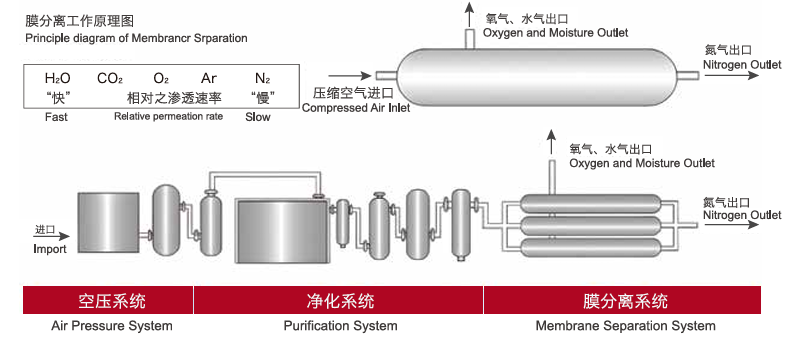
Membrane Separation Process
The process can be divided into three main sections.
1. Air Pressure System
Ambient air is compressed to provide the pressure required for membrane separation.
The capacity and operating condition of the compressed-air system should be matched to the selected nitrogen generator model.
2. Purification System
Before entering the membrane separation unit, compressed air is treated by the purification system.
The purpose of this stage is to provide suitable compressed air for stable operation of the membrane system and to protect the membrane modules from contaminants carried by the compressed-air supply.
3. Membrane Separation System
Purified compressed air enters the membrane modules.
Due to differences in gas permeability through the polymer membrane, the gas stream is separated. Faster-permeating components pass preferentially through the membrane, while nitrogen is retained and enriched before being delivered through the nitrogen outlet.
This type of hollow-fiber membrane separation is widely used for continuous on-site nitrogen production because the membrane module itself performs the separation without a chemical reaction or cryogenic phase-change process.
Product Characteristics
Simple Membrane Separation Process
The membrane separation system provides a simple and economical method for producing nitrogen from compressed air.
Its separation process is straightforward and does not require the cyclic adsorption and regeneration process used by PSA systems.
Fewer Moving Parts
The membrane separation section contains few moving parts, helping reduce the mechanical maintenance workload associated with the nitrogen generation process.
This makes membrane technology particularly suitable for applications where straightforward operation and maintenance are important.
Integrated Membrane Module Design
Standardized membrane components can be integrated into the nitrogen generation system according to the required production capacity.
The modular structure simplifies system integration, installation and operation.
Stable Nitrogen Supply
Once the compressed-air conditions and operating parameters are properly maintained, the membrane system can continuously separate nitrogen from the incoming compressed air to provide a stable nitrogen source for industrial processes.
Expandable Nitrogen Production Capacity
The modular characteristics of the membrane separation system allow production capacity to be configured according to actual nitrogen demand.
For projects with increasing nitrogen consumption, the system can be engineered with additional membrane capacity according to operating requirements.
Clean Product Nitrogen
The combination of compressed-air purification and membrane separation provides a clean nitrogen stream suitable for a range of industrial nitrogen applications.
Technical Parameters
The following specifications are based on the Hongbo current product manual.
HBFM95 Series
| Model | Gas Production (Nm³/h) | Air Consumption (Nm³/min) | Air Inlet DN (mm) | Nitrogen Outlet DN (mm) |
|---|---|---|---|---|
| HBFM95-50 | 50 | 2.1 | 32 | 25 |
| HBFM95-60 | 60 | 2.55 | 32 | 25 |
| HBFM95-70 | 70 | 2.9 | 32 | 25 |
| HBFM95-80 | 80 | 3.4 | 40 | 25 |
| HBFM95-100 | 100 | 4.25 | 40 | 25 |
| HBFM95-120 | 120 | 5.1 | 40 | 32 |
| HBFM95-150 | 150 | 6.38 | 50 | 32 |
| HBFM95-180 | 180 | 7.65 | 50 | 40 |
| HBFM95-200 | 200 | 8.5 | 50 | 40 |
| HBFM95-300 | 300 | 12.77 | 65 | 40 |
| HBFM95-400 | 400 | 17 | 65 | 50 |
| HBFM95-500 | 500 | 20.4 | 80 | 50 |
| HBFM95-600 | 600 | 24.5 | 80 | 50 |
| HBFM95-800 | 800 | 24.5 | 100 | 65 |
| HBFM95-1000 | 1000 | 32.6 | 100 | 65 |
| HBFM95-1200 | 1200 | 40.8 | 100 | 80 |
| HBFM95-1500 | 1500 | 61.2 | 125 | 80 |
| HBFM95-2000 | 2000 | 81.6 | 150 | 100 |
HBFM99 Series
| Model | Gas Production (Nm³/h) | Air Consumption (Nm³/min) | Air Inlet DN (mm) | Nitrogen Outlet DN (mm) |
|---|---|---|---|---|
| HBFM99-15 | 15 | 1.2 | 25 | 25 |
| HBFM99-20 | 20 | 1.6 | 25 | 25 |
| HBFM99-25 | 25 | 2 | 32 | 25 |
| HBFM99-30 | 30 | 2.4 | 32 | 25 |
| HBFM99-50 | 50 | 4 | 40 | 25 |
| HBFM99-60 | 60 | 4.8 | 40 | 25 |
| HBFM99-80 | 80 | 6.4 | 50 | 25 |
| HBFM99-100 | 100 | 8 | 50 | 25 |
| HBFM99-150 | 150 | 12 | 50 | 32 |
| HBFM99-180 | 180 | 14.4 | 65 | 40 |
| HBFM99-200 | 200 | 16 | 65 | 40 |
| HBFM99-250 | 250 | 20 | 65 | 40 |
| HBFM99-300 | 300 | 24 | 80 | 40 |
| HBFM99-350 | 350 | 28 | 80 | 40 |
| HBFM99-400 | 400 | 32 | 100 | 50 |
| HBFM99-450 | 450 | 36 | 100 | 50 |
| HBFM99-500 | 500 | 40 | 100 | 50 |
| HBFM99-600 | 600 | 48 | 100 | 50 |
| HBFM99-800 | 800 | 64 | 150 | 65 |
| HBFM99-1000 | 1000 | 80 | 150 | 65 |
| HBFM99-1200 | 1200 | 96 | 150 | 80 |
| HBFM99-1500 | 1500 | 120 | 200 | 80 |
| HBFM99-2000 | 2000 | 160 | 250 | 100 |
Design basis: The above data is based on 0.8 MPa(G) feed air, 20°C ambient temperature, 0 m elevation and 80% relative humidity.
Actual system configuration should be determined according to the required nitrogen flow, operating conditions and project requirements.
HBFM95 vs. HBFM99: How to Select the Right Series?
The two series should not simply be selected according to the largest available nitrogen flow. The required product-gas specification and actual nitrogen consumption should be considered together.
The parameter table also reveals an important engineering relationship.
For example:
- HBFM95-100 produces 100 Nm³/h with 4.25 Nm³/min air consumption.
- HBFM99-100 produces the same 100 Nm³/h with 8 Nm³/min air consumption.
Therefore, when selecting a membrane nitrogen generator, it is important to specify both the required nitrogen quality and required nitrogen flow. Selecting a unit based only on Nm³/h can lead to an incorrectly sized compressed-air system.
Hongbo can configure the membrane nitrogen generation system according to the customer's actual gas consumption and operating conditions.
Typical Industrial Applications
Membrane nitrogen generation is particularly useful where nitrogen needs to be generated continuously at the point of use and where a simple, compact gas separation process is preferred.
Typical applications include:
Chemical and Petrochemical Processes
Nitrogen can be used for process inerting, tank blanketing, pipeline purging and other operations where reducing contact with atmospheric oxygen is required.
Oil and Gas Operations
Membrane systems can be applied to nitrogen supply for purging, inerting and related field processes. Their modular construction and relatively simple separation process can be advantageous where installation space and maintenance accessibility are important.
Food Processing and Packaging
Nitrogen is used in certain food processing and packaging processes to control the atmosphere surrounding the product.
The required gas specification should be determined according to the specific food process rather than selecting a generator solely by nominal capacity.
Electronics and Industrial Manufacturing
Nitrogen can be used as a protective or inert process gas in manufacturing operations where oxidation control is required.
General Industrial Purging and Inerting
For factories with an existing compressed-air infrastructure, an on-site membrane nitrogen generator can provide nitrogen directly from compressed air and reduce dependence on externally transported nitrogen supplies.
Why Choose a Membrane Nitrogen Generator?
Membrane separation has a different operating mechanism from PSA and cryogenic air separation.
Its main value is not simply “higher purity” or “lower cost.” Instead, it is particularly useful when the process benefits from:
- Continuous nitrogen production
- Simple separation architecture
- Few moving components in the membrane section
- Compact system integration
- Relatively straightforward operation
- Modular capacity configuration
- On-site nitrogen generation from compressed air
For this reason, membrane technology should be selected according to the actual nitrogen specification and operating conditions, rather than treating it as a direct replacement for every PSA nitrogen generation application.
What Information Is Needed to Configure a Membrane Nitrogen Generator?
Correct sizing starts with the customer's actual nitrogen demand.
For a new project, the following information is particularly useful:
Required nitrogen flow: Nm³/h
Required nitrogen specification: according to the process requirement
Required outlet pressure: MPa or bar
Available compressed-air pressure: MPa or bar
Ambient temperature: °C
Installation altitude: m
Operating pattern: continuous or intermittent
Application: purging, inerting, blanketing, processing, etc.
This information allows the membrane system and upstream compressed-air equipment to be matched as a complete nitrogen generation solution.
FAQ
What is a membrane nitrogen generator?
A membrane nitrogen generator is an on-site gas generation system that uses differences in gas permeation rates through polymer membranes to separate nitrogen from compressed air. Oxygen, water vapor and other faster-permeating components preferentially pass through the membrane, while nitrogen is retained and enriched in the product stream.
What is the capacity range of Hongbo membrane nitrogen generators?
According to the current Hongbo product manual, the HBFM95 series covers 50–2000 Nm³/h, while the HBFM99 series covers 15–2000 Nm³/h.
How much compressed air does a membrane nitrogen generator require?
Air consumption depends on the model and required nitrogen specification. For example, according to Hongbo's current manual, HBFM95-100 requires 4.25 Nm³/min, while HBFM99-100 requires 8 Nm³/min under the stated design basis.
What conditions are Hongbo's technical parameters based on?
The published parameters are based on 0.8 MPa(G) feed air, 20°C ambient temperature, 0 m elevation and 80% relative humidity.
Does a membrane nitrogen generator require compressed-air treatment?
Yes. Proper air treatment is an important part of a membrane nitrogen generation system. Industrial membrane systems normally treat the compressed air before it enters the membrane modules in order to provide suitable feed-air conditions and protect the separation membrane.
Can the nitrogen generation capacity be expanded?
The membrane separation system has a modular structure. Capacity can therefore be configured according to the project's nitrogen demand, and system expansion can be considered when engineering the installation.
How should I select a membrane nitrogen generator?
At minimum, provide the required nitrogen flow, required nitrogen specification, outlet pressure, available compressed-air pressure, ambient conditions and application. Hongbo can then select an appropriate membrane system configuration.