
High-Purity Nitrogen Purification
Hongbo HBTDC Series Carbon Addition and Deoxidation Nitrogen Purification System is designed for the
The system takes approximately 99.9% nitrogen as feed gas and removes residual oxygen through a carbon deoxidation process. During purification0.1% residual oxygen in the nitrogen reacts chemically with the carbon deoxidizer to form carbon dioxide.
After treatment, the nitrogen can be purified to over 99.999%, making the system suitable for industrial processes with stringent requirements for nitrogen purity and product gas quality.
Unlike a standalone nitrogen generator, the HBTDC series is a downstream nitrogen purification system. It is typically integrated with a nitrogen generation unit to form a complete high-purity nitrogen supply system.
How Carbon Deoxidation Nitrogen Purification Works
The purification process combines carbon deoxidation, cooling,.
Nitrogen produced by the upstream nitrogen generation system still contains a small amount of residual oxygen. For
The feed nitrogen first enters the carbon deoxidation section, where the gas is
The main deoxidation reaction can be expressed as:
C + O
Residual oxygen reacts with carbon to form carbon dioxide.
The gas leaving the deoxidation section therefore contains the newly generated CO₂ as
The downstream purification
This combination of carbon deoxidation followed by adsorption purification is also an established industrial route for removing residual oxygen without introducing hydrogen into the product stream.
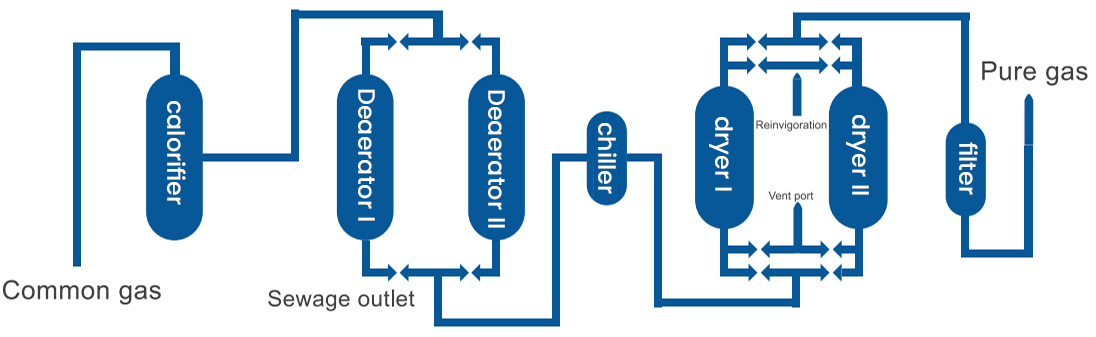
Process Flow
According
Feed Nitrogen → Heater → Carbon Deoxidation
The uploaded product
Common Gas → Heater → Deoxidation Tower → Ch
Each section performs a specific function in the purification process
1. Feed Nitrogen
The system receives nitrogen produced by the upstream nitrogen generation equipment.
For the HBTDC series, the product manual describes the feed nitrogen as approximately 99.9% N₂, containing about 0.1% residual oxygen.
2. Heating and Carbon Deoxidation
The nitrogen is heated before entering the deoxidation section.
Residual oxygen reacts with the carbon deoxidizer, converting oxygen into carbon dioxide:
C + O₂ → CO₂
This stage performs the primary oxygen-removal function.
3. Cooling
After deoxidation, the process gas is cooled before entering the downstream purification section.
Cooling prepares the gas for subsequent moisture and impurity removal.
4. Adsorption and Drying
Carbon dioxide generated during deoxidation and water vapor contained in the gas are removed in the adsorption purification section.
The system uses alternating adsorption vessels to support continuous purification operation.
5. Final Filtration
The treated nitrogen passes through the downstream filtration section before being delivered as high-purity product gas.
The complete process raises the nitrogen purity from approximately 99.9% to over 99.999%, according to the current Hongbo product manual.
Why Use Carbon Deoxidation for Nitrogen Purification?
One of the important characteristics of this purification route is that oxygen removal is achieved through a reaction with carbon rather than by introducing hydrogen.
This makes carbon deoxidation particularly relevant to applications where the process requires high-purity nitrogen and places restrictions on hydrogen in the product gas.
Other industrial carbon-deoxidation systems use the same fundamental approach: residual oxygen reacts with carbon to form CO₂, after which CO₂ and moisture are removed by downstream adsorption and drying.
For an industrial nitrogen supply system, the HBTDC purification unit therefore performs a different function from the upstream PSA or other nitrogen generator:
The nitrogen generator produces nitrogen; the HBTDC purification system further removes residual impurities to obtain high-purity product nitrogen.
This distinction should be made clear on the product page.
Product Characteristics
Nitrogen Purity Above 99.999%
The HBTDC series further purifies approximately 99.9% nitrogen from the upstream nitrogen generation system.
After carbon deoxidation and downstream purification, product nitrogen purity can reach over 99.999%, according to the current Hongbo product manual.
Carbon-Based Oxygen Removal
Residual oxygen reacts chemically with the carbon deoxidizer and is converted into carbon dioxide.
The generated CO₂ can then be removed in the downstream purification process.
No Hydrogen Addition Required for Deoxidation
Because carbon is used as the reactant for removing residual oxygen, the carbon deoxidation process does not rely on hydrogen addition for the oxygen-removal reaction.
This is an important distinction when comparing carbon deoxidation with hydrogen-based catalytic deoxidation processes.
Integrated Purification Process
The system combines several treatment stages:
Heating → Deoxidation → Cooling → Drying → Filtration
Rather than performing only oxygen removal, the complete system also addresses the CO₂ and moisture generated or carried through the purification process.
Designed for Integration with Nitrogen Generation Systems
The HBTDC series is intended for use downstream of nitrogen generation equipment.
It can therefore be configured as part of an integrated high-purity nitrogen generation and purification system according to the customer's required flow and process conditions.
Multiple Capacity Options
The current Hongbo HBTDC series provides multiple standard configurations for different nitrogen treatment capacities.
The manual lists models from HBTDC-130 through HBTDC-2400, allowing the purification unit to be matched to different high-purity nitrogen demands.
Technical Parameters
The following specifications are taken from the current Hongbo product manual.
| Model | 99.9% N₂ Processing Capacity (Nm³/h) | Inlet & Outlet | Carbon Deoxidizer Power (kW) | Purification Tower/Dryer Power (kW) | Total Power (kW) | Cooling Water (t/h) | Equipment Footprint (mm) |
|---|---|---|---|---|---|---|---|
| HBTDC-130 | ≤90 | DN25 | 15 | 3 | 18 | 0.3 | 2500 × 1350 × 2300 |
| HBTDC-200 | ≤140 | DN40 | 24 | 4.5 | 28.5 | 0.8 | 2700 × 1550 × 2600 |
| HBTDC-300 | ≤210 | DN40 | 27 | 6 | 33 | 1.2 | 2850 × 1850 × 2850 |
| HBTDC-430 | ≤300 | DN50 | 39 | 9 | 48 | 1.8 | 3500 × 2100 × 3350 |
| HBTDC-670 | ≤470 | DN50 | 54 | 12 | 66 | 2.2 | 3700 × 2100 × 3400 |
| HBTDC-800 | ≤560 | DN65 | 63 | 15 | 78 | 3.0 | 4000 × 2100 × 3600 |
| HBTDC-1200 | ≤840 | DN65 | 90 | 15 | 105 | 4.5 | 4500 × 2100 × 3800 |
| HBTDC-1600 | ≤1120 | DN80 | 114 | 18 | 132 | 7.9 | 5500 × 2800 × 3800 |
| HBTDC-2400 | ≤1680 | DN100 | 150 | 21 | 171 | 10.5 | 6500 × 3000 × 3800 |
Design basis: The above data is based on 0.8 MPa(G) feed gas, 20°C ambient temperature, 0 m elevation and 80% relative humidity.
Actual equipment selection should be based on the required nitrogen flow, feed-gas conditions, required product-gas specification and operating conditions.
Understanding the HBTDC Model Selection
There is one detail here that I think is very useful for procurement engineers and should be explained instead of simply presenting the parameter table.
The number in the HBTDC model designation is not identical to the 99.9% nitrogen processing capacity shown in the table.
For example:
- HBTDC-130 → ≤90 Nm³/h
- HBTDC-300 → ≤210 Nm³/h
- HBTDC-800 → ≤560 Nm³/h
- HBTDC-1200 → ≤840 Nm³/h
- HBTDC-2400 → ≤1680 Nm³/h
Therefore, customers should not select an HBTDC purification unit solely according to the model number.
The required feed nitrogen flow, nitrogen quality and final product-gas requirements should be provided before equipment selection.
Typical Applications
According to the current Hongbo product manual, the HBTDC carbon deoxidation purification system is intended for high-purity nitrogen users, particularly industries with strict requirements for oxygen and hydrogen.
Magnetic Materials
Manufacturing and heat-treatment processes for certain magnetic materials require controlled atmospheres to minimize oxidation.
High-purity nitrogen can be used to establish a protective atmosphere during relevant production stages.
Electronics Manufacturing
Certain electronics production processes are sensitive to residual oxygen and require a stable high-purity nitrogen atmosphere.
The HBTDC system can be integrated with an upstream nitrogen generator to provide further purification where standard nitrogen purity is insufficient for the process.
Metal and Heat-Treatment Processes
High-purity nitrogen is used in selected metal processing and heat-treatment operations to reduce undesirable oxidation and maintain controlled processing atmospheres.
Other Oxygen-Sensitive Processes
The system can also be considered for industrial processes where approximately 99.9% nitrogen does not satisfy the required gas specification and further oxygen removal is necessary.
The suitability of the equipment should ultimately be determined according to the user's actual gas specification and production process.
HBTDC Nitrogen Purifier vs. Standard Nitrogen Generator
These two pieces of equipment should not be confused.
A standard nitrogen generator performs the primary separation of nitrogen from air.
The HBTDC Carbon Addition and Deoxidation Nitrogen Purification System is a downstream purification unit designed to further treat the nitrogen already produced by the nitrogen generation system.
A typical complete configuration can therefore be understood as:
Compressed Air
↓
Air Purification
↓
Nitrogen Generator
↓
Approx. 99.9% N₂
↓
HBTDC Carbon Deoxidation Nitrogen Purification System
↓
High-Purity N₂ >99.999%
This relationship is worth showing graphically on the webpage because it immediately tells a technical buyer where this product sits in the complete nitrogen generation system.
Carbon Deoxidation vs. Hydrogen Deoxidation
This section is also worth adding because it gives the product page considerably more technical depth without introducing unsupported product parameters.
Both carbon-based and hydrogen-based purification can be used to remove residual oxygen from nitrogen, but their reaction mechanisms are different.
In a carbon deoxidation system:
C + O₂ → CO₂
The resulting CO₂ must subsequently be removed.
In hydrogen deoxidation, hydrogen reacts with residual oxygen to form water, which must then be removed by downstream drying.
The important point is therefore not that one method is universally “better.” Selection depends on the required product-gas composition, available utilities and process restrictions.
For users whose process places strict restrictions on hydrogen, carbon deoxidation provides an oxygen-removal route without hydrogen addition. Carbon-based purification systems are consequently used in applications where high nitrogen purity is required but introducing hydrogen is undesirable.
What Information Is Required for Equipment Selection?
For proper HBTDC system selection, customers should provide:
Feed nitrogen flow: Nm³/h
Feed nitrogen purity: %
Required product nitrogen purity: %
Operating pressure: MPa or bar
Required outlet pressure: MPa or bar
Operating hours: hours/day
Ambient temperature: °C
Installation altitude: m
Cooling-water conditions: if applicable
Application/process: magnetic materials, electronics, heat treatment, etc.
These conditions allow Hongbo engineers to determine the appropriate purification capacity and system configuration.
FAQ
What is a carbon deoxidation nitrogen purification system?
It is a downstream nitrogen purification system that removes residual oxygen from nitrogen through a reaction between oxygen and carbon. The resulting carbon dioxide is subsequently removed together with moisture through downstream purification and drying.
What nitrogen purity can the Hongbo HBTDC series achieve?
According to the current Hongbo product manual, the system processes approximately 99.9% feed nitrogen and can purify the product nitrogen to over 99.999%.
Does the HBTDC system generate nitrogen directly from compressed air?
No. The HBTDC series is primarily a nitrogen purification system, not the primary air-separation stage. It is designed to further purify nitrogen supplied by an upstream nitrogen generation system.
How does the system remove residual oxygen?
Residual oxygen reacts with the carbon deoxidizer:
C + O₂ → CO₂
The generated CO₂ is then removed in the downstream purification section.
Does carbon deoxidation require hydrogen addition?
The carbon deoxidation reaction itself uses carbon rather than hydrogen to remove residual oxygen. This makes the process relevant for applications where hydrogen addition to the purification process is undesirable.
What is the processing capacity of the HBTDC series?
According to the current product manual, standard HBTDC configurations cover 99.9% nitrogen processing capacities from ≤90 to ≤1680 Nm³/h, depending on model.
What conditions are the published technical parameters based on?
The current manual states a design basis of 0.8 MPa(G) feed gas, 20°C ambient temperature, 0 m elevation and 80% relative humidity.
How do I select the correct HBTDC model?
Selection should be based on feed nitrogen flow, feed purity, required final nitrogen purity, pressure, operating conditions and application rather than model number alone.