
1. Product Overview
The HBDC Series Hydrogenation and Deoxygenation Type Nitrogen Purification Device is designed to further purify nitrogen by removing residual oxygen and moisture from the nitrogen stream.
The system uses a high-efficiency palladium deoxidation catalyst. A controlled amount of hydrogen is introduced into the nitrogen stream, allowing residual oxygen to react with hydrogen over the catalyst and form water. The treated gas is then cooled and dried to obtain purified nitrogen.
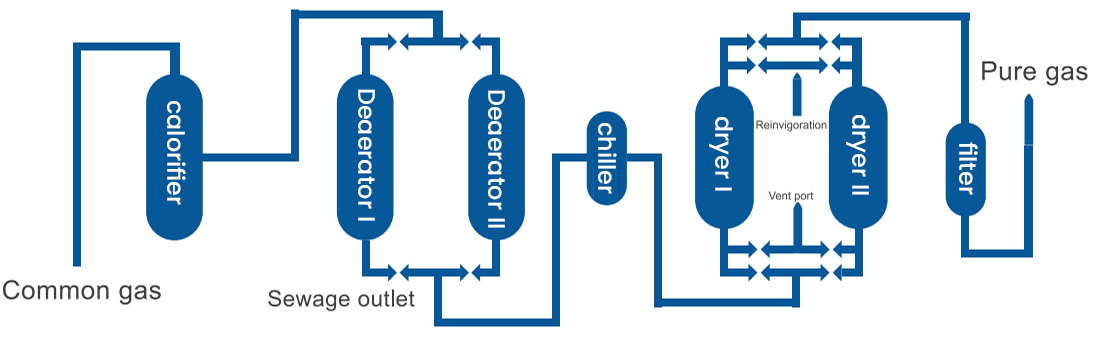
According to the HBDC product configuration, the system integrates hydrogenation, catalytic deoxygenation, cooling, moisture removal and molecular sieve drying into one purification unit. PLC-based automatic control can be used to manage operating and regeneration cycles.
The HBDC Series is available in models from HBDC-20 to HBDC-1000, with pure nitrogen production capacities from 20 to 1000 Nm³/h.
Important: The final nitrogen purity, residual oxygen concentration and dew point should be specified according to the customer's inlet nitrogen quality and required application. The current product manual does not provide a single universal outlet oxygen specification, so the product page should not invent a fixed purity such as 99.9999% or 1 ppm.
2. How HBDC Nitrogen Purification Works
Catalytic Hydrogenation and Deoxygenation
The HBDC purification process is based on catalytic reaction between hydrogen and residual oxygen in the nitrogen stream.
The basic reaction is:
2H₂ + O₂ → 2H₂O
A controlled quantity of hydrogen is introduced into the incoming nitrogen and mixed before the gas enters the palladium catalyst bed. The residual oxygen reacts with hydrogen on the catalyst surface, producing water vapor. This is the basic principle used in catalytic deoxygenation of nitrogen.
After deoxygenation, the gas passes through the cooling and drying stages. The generated moisture is removed, while 13X molecular sieve is used for further adsorption drying.
Typical Process Sequence
Common Nitrogen → Hydrogen Addition → Palladium Catalytic Deoxygenation → Cooling → Moisture Separation → Molecular Sieve Drying → Filtration → Purified Nitrogen
The HBDC flow diagram in the product manual shows the purification process with hydrogen addition, deoxygenation, cooling and dual-tower drying before the purified nitrogen outlet.
3. Main Features
1. Advanced Palladium Catalyst Technology
The HBDC Series adopts a high-efficiency palladium deoxidation catalyst with good catalytic activity.
According to the product manual, the catalyst is designed to operate without external heating under the specified process conditions, and no separate activation or regeneration of the deoxidation catalyst is required.
Catalytic removal of residual oxygen from nitrogen using hydrogen over palladium-based catalysts is an established purification approach.
2. Automatic PLC Control
The system uses PLC control for automatic operation.
The control system can manage the operating sequence and automatic switching between working and regeneration stages of the drying section, reducing the need for continuous manual operation.
3. Automatic Hydrogenation
The HBDC Series can be equipped with a mass flow controller for controlled hydrogen addition.
The hydrogenation system can automatically control the hydrogen flow and hydrogen-to-nitrogen ratio according to the configured operating requirements.
This is important because hydrogen addition needs to be controlled according to the residual oxygen content and process flow rather than simply adding a fixed amount of hydrogen. Industrial nitrogen purification systems commonly use controlled hydrogen dosing before the catalytic reactor.
4. Integrated Drying System
The water generated during the catalytic deoxygenation process needs to be removed before the purified nitrogen is delivered to the downstream process.
The HBDC system therefore incorporates:
- Cooling
- Moisture removal
- 13X molecular sieve drying
- Dual-tower automatic switching
- Final gas filtration
The 13X molecular sieve is used for deep adsorption of residual moisture after the deoxygenation stage.
5. Reliable Control Components
According to the product manual, the equipment can use:
- German Baode pneumatic valves
- German Baode solenoid valves
- Xiamen Yuguang temperature controller
These components are integrated into the automatic control system to support stable operation of the purification equipment.
6. Compact Integrated Design
The HBDC Series adopts an integrated skid-mounted structure with the major purification and control components arranged as a complete system.
The manual describes the equipment as having:
- Compact structure
- Small floor area
- Integrated control
- Convenient installation
- Clean equipment appearance
This makes the HBDC suitable for installation downstream of an existing nitrogen generation system.
4. HBDC Series System Configuration
The HBDC system can be understood as a nitrogen polishing and purification stage, rather than a primary nitrogen-generation system.
A typical configuration includes:
01 — Nitrogen Inlet
Common nitrogen enters the purification system from an upstream nitrogen generator or nitrogen supply system.
02 — Hydrogen Addition
A controlled amount of hydrogen is introduced into the nitrogen stream.
03 — Palladium Deoxygenation
The mixed gas enters the catalytic deoxygenation section, where residual oxygen reacts with hydrogen to form water.
04 — Cooling
The gas temperature is controlled through the cooling section after the catalytic reaction.
05 — Moisture Removal
Generated moisture is separated from the gas stream.
06 — Molecular Sieve Drying
The nitrogen passes through the drying section containing 13X molecular sieve.
07 — Automatic Regeneration / Switching
The dual-tower drying system can automatically switch between adsorption and regeneration operation under PLC control.
08 — Final Filtration
The purified nitrogen passes through the final filtration stage before leaving the equipment.
09 — Purified Nitrogen Outlet
The resulting purified nitrogen is supplied to the downstream production process.
5. Technical Parameters
| Model | Common Nitrogen Consumption (Nm³/h) | Pure Nitrogen Production (Nm³/h) | Hydrogenation Flow (Nm³/h) | Inlet/Outlet Diameter | Palladium Catalyst Weight (kg) | 13X Molecular Sieve Weight (kg) | Applied Power (kW) | Cooling Water (t/h) | Equipment Size (mm) |
|---|---|---|---|---|---|---|---|---|---|
| HBDC-20 | 22 | 20 | 0.44 | DN25 | 4.8 | 60 | 2.1 | 0.3 | 1700×1000×2300 |
| HBDC-40 | 44 | 40 | 0.88 | DN25 | 9.6 | 120 | 2.1 | 0.3 | 1700×1000×2500 |
| HBDC-60 | 66 | 60 | 1.32 | DN25 | 14.4 | 180 | 5.5 | 0.3 | 1800×1100×2600 |
| HBDC-80 | 88 | 80 | 1.76 | DN40 | 19.2 | 240 | 5.5 | 0.3 | 2000×1200×2600 |
| HBDC-100 | 110 | 100 | 2.20 | DN40 | 24 | 300 | 7 | 0.4 | 2400×1300×2600 |
| HBDC-150 | 165 | 150 | 3.30 | DN40 | 36 | 450 | 7 | 0.4 | 2500×1500×2700 |
| HBDC-200 | 220 | 200 | 4.40 | DN50 | 48 | 600 | 14.7 | 0.5 | 2650×1650×2800 |
| HBDC-250 | 275 | 250 | 5.50 | DN50 | 60 | 750 | 14.7 | 0.6 | 2700×1700×3200 |
| HBDC-300 | 330 | 300 | 6.60 | DN50 | 72 | 900 | 14.7 | 0.6 | 2800×1800×3200 |
| HBDC-350 | 385 | 350 | 7.70 | DN65 | 84 | 1050 | 14.7 | 0.7 | 2800×1800×3400 |
| HBDC-400 | 440 | 400 | 8.80 | DN65 | 96 | 1225 | 16.5 | 0.8 | 3100×2000×3400 |
| HBDC-450 | 495 | 450 | 9.90 | DN80 | 108 | 1350 | 16.5 | 1.0 | 3100×2000×3600 |
| HBDC-500 | 550 | 500 | 11.00 | DN80 | 120 | 1500 | 16.5 | 1.2 | 3400×2300×3600 |
| HBDC-600 | 660 | 600 | 13.20 | DN80 | 144 | 1800 | 21 | 1.5 | 3400×2300×3800 |
| HBDC-700 | 770 | 700 | 15.40 | DN100 | 168 | 2100 | 21 | 1.8 | 3800×2600×3800 |
| HBDC-800 | 880 | 800 | 17.60 | DN100 | 192 | 2400 | 22.5 | 1.8 | 3800×2600×4000 |
| HBDC-900 | 990 | 900 | 19.80 | DN100 | 216 | 2700 | 28.5 | 2.0 | 4400×2800×4000 |
| HBDC-1000 | 1100 | 1000 | 22.00 | DN100 | 240 | 3000 | 28.5 | 2.0 | 4400×2800×4000 |
Note: Actual equipment configuration and operating conditions should be confirmed according to the customer's nitrogen inlet quality, required nitrogen production, hydrogenation requirements and downstream application.
6. Application
The HBDC Series is intended for applications where the nitrogen produced by a conventional nitrogen generation system requires further purification and oxygen removal.
Typical application scenarios include:
Nitrogen Generation System Upgrading
Used downstream of PSA or other nitrogen generation systems as an additional purification stage.
Oxygen-Sensitive Manufacturing
Suitable where residual oxygen in nitrogen may affect the downstream production process.
Heat Treatment and Metallurgy
Purified nitrogen can be used as a protective or process atmosphere where oxygen control is important.
Electronics and Industrial Manufacturing
Can be integrated into gas supply systems requiring improved nitrogen purity.
Research and Process Gas Systems
Suitable for applications requiring controlled nitrogen quality and stable gas supply.
The exact application should be selected according to the required oxygen concentration, moisture level, gas flow and downstream process conditions. Catalytic deoxygenation is commonly used as a polishing stage after non-cryogenic nitrogen generation.
7. Why Choose HBDC Series Nitrogen Purification Device?
Integrated Hydrogenation and Deoxygenation
Instead of treating the palladium catalyst as an independent component, the HBDC Series integrates hydrogen addition, catalytic deoxygenation, cooling and drying into one complete purification system.
Automatic Operation
PLC-based control allows automatic operation and switching of the drying system, reducing manual intervention.
Controlled Hydrogen Addition
The optional mass flow controller provides controlled hydrogenation and allows the hydrogen ratio to be managed according to process requirements.
Palladium Catalytic Deoxygenation
The palladium catalyst provides an efficient route for removing residual oxygen from nitrogen through catalytic reaction with hydrogen.
Complete Moisture Removal Process
Cooling, moisture separation and 13X molecular sieve drying are integrated to remove water generated during the deoxygenation process.
Wide Capacity Range
The HBDC Series covers 20–1000 Nm³/h pure nitrogen production, allowing the equipment to be selected according to different nitrogen demand levels.
Compact System Design
The integrated structure helps reduce the installation footprint compared with a system assembled from separate purification components.
8. HBDC Series vs. Conventional Nitrogen Supply
For some applications, nitrogen from a PSA or membrane nitrogen generator may already satisfy the basic process requirement. However, applications with stricter oxygen requirements may need an additional purification stage.
The HBDC Series provides this additional deoxygenation and drying stage.
Nitrogen Generator
↓
Common Nitrogen
↓
HBDC Hydrogenation
↓
Palladium Catalytic Deoxygenation
↓
Cooling & Moisture Removal
↓
13X Molecular Sieve Drying
↓
Final Filtration
↓
Purified Nitrogen
This positioning is important for SEO as well: HBDC should not be positioned as another type of nitrogen generator. It should be positioned as a nitrogen purification / deoxygenation system used after nitrogen generation.
9. FAQ
What is the HBDC Series?
The HBDC Series is a hydrogenation and deoxygenation type nitrogen purification device designed to remove residual oxygen and moisture from nitrogen.
How does the HBDC nitrogen purifier remove oxygen?
Hydrogen is introduced into the nitrogen stream and reacts with residual oxygen over a palladium catalyst. The reaction converts oxygen and hydrogen into water, which is subsequently removed through cooling, moisture separation and drying.
Does the HBDC system require external heating?
According to the product manual, the HBDC Series uses a high-efficiency palladium deoxidation catalyst that can operate without external heating under the specified process conditions.
Does the palladium catalyst require regeneration?
The product manual states that no activation regeneration is required for the deoxidation catalyst.
How is hydrogen controlled?
The HBDC system can be equipped with a mass flow controller for automatic hydrogen addition and control of the hydrogen concentration ratio.
What is the function of the 13X molecular sieve?
The 13X molecular sieve is used in the drying stage to adsorb residual moisture after the catalytic deoxygenation process.
Can HBDC be connected to an existing nitrogen generator?
Yes. The HBDC Series is designed as a downstream nitrogen purification unit and can be configured according to the nitrogen flow and inlet gas conditions of the upstream system.
What capacity models are available?
The HBDC Series covers models from HBDC-20 to HBDC-1000, corresponding to pure nitrogen production capacities from 20 to 1000 Nm³/h according to the product manual.
How do I select the correct HBDC model?
Model selection should consider:
- Required pure nitrogen flow
- Common nitrogen inlet flow
- Hydrogenation flow
- Nitrogen inlet/outlet diameter
- Required nitrogen quality
- Cooling water availability
- Installation space
- Downstream application requirements
Hongbo can select the appropriate HBDC model based on the customer's actual operating conditions.